Tuesday, April 17, 2012

The BFG

By Roald Dahl
Illustrations by Quentin Blake
Published by Farrar • Straus • Giroux
Copyright © 1982

The BFG (Big Friendly Giant) is just another example of Roald Dahl’s childlike imagination combining with his social awareness, making for a moralistic tale that children can’t help but like.

Sophie lives in an orphanage. It is not a very nice place to live because the supervisors are very strict and love to punish children. One night Sophie could not sleep, and even though she knew she could be punished she got out of bed and tiptoed to the window where the moonlight was beaming through. When she looked out the window the homes and streets all around were quiet and there was nothing moving about. Soon however, she noticed a large shadowy figure looking into people homes. As he got closer to the orphanage Sophie went quickly back to her bed. But soon the large creature was at the orphanage and he reached in, grabbed Sophie, and ran speedily away.

Sophie was fortunate however, she had been kidnapped by the BFG. Had it been any other Giant she would have been eaten on the spot, but the BFG did not like to eat people.  He merely skulked around so that he could blow good dreams into children’s rooms. The BFG had to kidnap Sophie because she had seen him, and she certainly would have told everyone what she had seen first thing in the morning, and then they would have tried to capture him.

The BFG had problems enough back in Giantland without worrying about being caught by people. In Giantland the BFG was actually a runt; the other giants were twice his size. They were mean, cruel, and people eaters. They took every opportunity they could to bully the poor BFG, and every night they would run off to various countries and eat unsuspecting people. But now that Sophie was living with the BFG in Giantland this would have to stop.

In the BFG Roald Dahl tells the enjoyable story of an orphaned girl and a friendly and funny talking giant who become friends and find away to stop the mean giants. The funny made up words and names in this book are pure Dahl. While it is written from Sophie’s viewpoint, it is the BFG who steals the show because he is so silly and lovable. What I really enjoyed about this book was the lesson behind the story. While each creature has its own morality (rules for what is right or wrong) humans are the only ones that think it is okay to purposefully hurt others of their own kind. Giants would certainly never do this. Even though the other giants treat the BFG badly they would never kill him. This isn’t my favorite Dahl book, but it is one of my favorite morals. And this is a book that children 7 and up would likely enjoy.

Thursday, April 12, 2012

Who Was First?: Discovering the Americas

By Russell Freedman
Published by Clarion Books
Copyright © 2007

We are all taught in grade school that “in fourteen hundred and ninety-two, Columbus sailed the ocean blue”. Columbus is given much of the credit for discovery the Americas. We still have national holiday designated for his seeming accomplishment. But did Christopher Columbus really discover America?

“Who was first?” examines that question in relative detail providing accurate summations of probable discoverers of America prior to 1492. This list includes among others the Chinese and of course the Vikings. Though the evidence seems a bit light on the side of the Chinese the case is made that it is certainly within the realm of possibility. On the other hand there seems to be much more proof to crown the Vikings as discoverers of America which pre-dates Chinese exploration and makes it a moot point.     

However no discussion of the discovery of America would be complete without taking a look at the Native Americans who were already present in the time of Columbus and the Viking’s Leif Eriksson. The question is briefly posed: where did these natives come from? The Answer that we are familiar with is that they came across Beringia (the arctic land bridge) from Asia, but there is some thought that their may be some natives of European origin as well. While some may not agree with the Radio-carbon dates provided in this portion of the book, The Native migration order, fossil finds, and routes of travel are more or less accurate if not the dates.

“Who was First?” is a great educational book for the 4th through the 8th grade. It is even a good book for the adult looking for clear and succinct information on the subject, as it was a quick read and it kept my attention.

Tuesday, April 10, 2012

Thirteen Reasons Why

Thirteen Reasons Why
by Jay Asher
Published by Razor Bill
Copyright © 2007


This is one of the most compelling books I’ve read in a long time. Suicide is certainly not a pick me up, make me feel better subject. But Asher’s use of double narrative and the mystery of motive grab you and don’t let you go.

Clay Jensen comes home from school and finds a package on his front porch addressed to him. His life has already bruised by the suicide of Hannah Baker, but what he finds in that package will shatter him.

Hannah Baker committed suicide a couple of weeks ago, and nobody knew why? She did though, and she decided to share those reasons. Not with the entire world mind you, not unless they forced her. She made a list of the thirteen people who had altered her life since she had moved to this town. She then recorded seven audio cassettes, one side per a person and told the story of their interaction. Before she kills herself she sends these tapes to the first person on her list.

At the very beginning of her recording she instructs the listener that when they are done with the tapes that they must send them on to the next person on the list or else there is a second set of tapes that will go public. Why does she do this? Because she wants everyone on the list to understand that what they do and say has an effect. Everyone and everything is connected in some way.

We see the impact of these tapes through the thoughts and reactions of Clay Jensen. Clay immediately wonders why he is on these tapes, because he can’t think of anything that he did to Hannah Baker. To the contrary he really liked her and was a bit too shy to talk to her the way he wanted. But he listens anyway and we listen along with him as Hannah narrates her story.

“Thirteen Reasons Why” is a bit mysterious and mildly disturbing. While the content of this book may be a bit mature in places, I think that this is a book that every teen (13 and up) should read at some point during their high school careers. This tale is not so much a rally against suicide as it is a rally for compassion. So many times we do and say things that we think will have no effect on others, and other times we are just outright selfish and don’t care about others. This book is begs you to think about what you are doing. This book is a call to action. If you see someone who displays suicidal tendencies show them that you care and don’t give up just because they push you away. Sometimes how hard you try shows how much you care.

Monday, April 9, 2012

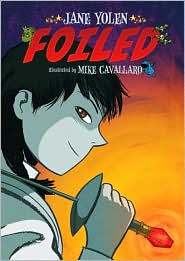
Foiled

By Jane Yolen
Illustrated by Mike Cavallaro
Published by :01 First Second
Copyright © 2010


Foiled is a wonderful new Graphic Novel. Aliera Carstairs is a fencing phenom. Her mom is a seasoned veteran…in shopping on the cheap. At one particular Tag Sale at a school Aliera’s mother finds her a practice foil for fencing class and purchases it for $2.00! It is a very good foil except for this tacky looking fake ruby on the end of the handle. Aliera wants to remove it, but she can’t.

While Aliera is hot stuff in fencing class, in High School, she is pretty much ignored. This doesn’t seem to bother her much until a new kid comes to school. He is absolutely gorgeous, beautiful even, and he ends up being her science partner. Aliera finds herself very attracted to him, but very irritated by him all at the same time. There is something not quite right about him, but she just can’t figure it out. When he asks her out on a date, she soon realizes that things are certainly not what they seem.

The lead character in this graphic novel is a strong independent female, but this book should appeal to boys with its sword play (sorry weapon play — read the book you’ll get the correction) and its hint of the supernatural. I really enjoyed the use of fencing for this novel; it is a very athletic sport that doesn’t get the attention it should. This is a great teen read.

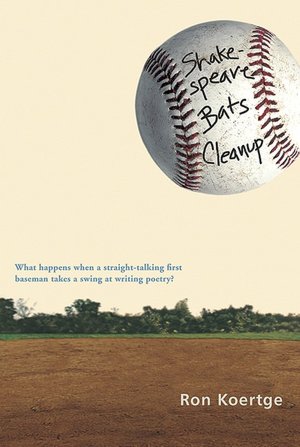
Shakespeare Bats Cleanup

by Ron Koertge
Published by Candlewick Press
Copyright © 2003

I am a big baseball fan, and I just so happen to like poetry. There is something about the game of baseball that brings out the poet and writer in many men. The game has a soul. It’s contemplative. It’s youth at it’s core. Author, Ron Koertge, gives us just a little touch of that in this book.

 Kevin Boland loves baseball. Well baseball and girls – he is 14 hello. But baseball seems to be his life he is a great first baseman with a sweet stroke. But when he catches mono his baseball life is derailed. He is too sick and weak to play ball. Since he is pretty much confined to his house and tired much of the time Kevin picks one of his Dad’s books on poetry styles. He starts to write just to have something to do, but it isn’t until he gets better and he can do whatever he wants that he realizes what he really wants to do is write poetry. He hasn’t dropped baseball, but he realizes that he enjoys writing as well.

Kevin’s poetry is a reflection of his personal life. At first it is mostly about baseball, but soon he finds himself writing about the loss of his mother, his father’s coping skills, and of course girls.

This quick, but wonderful, read is especially great for tween and early teen boys. I think it really shows that while sports are fun, and to some extent important, they are not life. I also think that Kevin’s character shows that being sensitive doesn’t mean being week, it means being able to share how you feel. Great book!