Showing posts with label Book Reviews. Show all posts

Wednesday, July 18, 2012

Hitch

By Jeanette Ingold
Published by Harcourt, Inc.
Copyright © 2005

Moss Trawnley is 17 and he is doing everything he can to keep his family afloat. Considering that he is living during the tail end of the great depression and he still has his job at an airfield in Texas he feels pretty hopeful. He is able to send money home to his family in Louisiana every month, he is planning to go to radio repair school, and he has girlfriend named Beatty. However, when Moss suddenly loses his job his dreams seem to be turned on end.

After locating his father in Montana, Moss decides to sign up for a hitch with the Civilian Conservation Corps where he will get 3 squares and a cot and two-thirds of his pay will be sent home to help his family. Moss endures extreme weather and troublesome cabin mates, but he also learns what it takes to be a good man and a leader. He learns the meaning and value of hard work, helping others, and of loyalty.

The Civilian Conservation Corps was one of Franklin Delano Roosevelt’s initial New Deal programs designed to put the nation’s young men to work during the Great Depression. They were charged with among other things the tasks of reforestation, dam and reservoir construction, and park restoration. Ingold tells a fascinating story that shows why a young man might join the CCC and what camp life might be like. 

More than just being an overview of the CCC though, she creates a likeable protagonist for us who is coping with internal and external conflicts. And she highlights the proper way to deal with those conflicts. While reading Moss’ story you are waiting for him to lash out because it is the natural first instinct, but he learned from his experience what happens when you do that. Moss is a flawed character but he is good at heart, accepts subtle direction, and learns the best ways to lead. 

In addition to Moss she shows young men and women who have many different talents and passions. I thought it was great that there were young men who loved to read and were good in the kitchen and that there were young ladies who were pilots and were interested in the family farm. It is a reminder that it is our abilities and interests that should guide our work and passions, not our sex.

While the characters in this story tend to be 17 and older, I feel that youths 12 and up would enjoy this story. This book would also be well used in middle/high school language arts classes to make a cross curriculum connection with U.S. History in particular the Great Depression and the New Deal era.

Friday, June 29, 2012

Mercury

By Hope Larson
Published by Atheneum
Copyright © 2010

“Mercury” is, for me, the embodiment of a great graphic novel. Larson tells a strong story that is realistic with just a hint of magic. And her illustrations show so well just what can be done in simple black and white.

Josie Fraser has her heart set on her best friend’s brother Jonathan, until a stranger by the name of Asa Curry comes to the farm. He seems like a good God fearing young man and he is handsome to boot. He has come to propose a business venture with Josie’s father, he wants to form a partnership with him and mine for gold on his property. Josie falls in love with him and they plan to marry, but she soon learns that Asa isn’t what he seems.

150 years later Josie’s descendant, Tara Fraser, is living with her Aunt in the same town. Tara’s mother has been working in Alberta since their house burned down back home. Her mother wants to sell the family property and have Tara move to Alberta with her, but Tara is less than enthused about this idea. That house and property had been in Tara and Josie’s family for a long time, and Tara isn’t ready to give up on it.

As we read Josie’s story slipping into tragedy and sadness, we simultaneously get to read of Tara’s story rising from tragedy and sadness into hope that has its roots in the Nova Scotia Gold Rush.

Hope Larson takes us to a place that most of us have never been, or even thought of going, and she takes us to a time and event that we didn’t even know happened. I had no idea that there was a Nova Scotia gold rush, but there was one in the 1860’s and beyond. In truth there is still small scale gold mining there today. I love stories that can inform and transport you to such events.

In addition to the story the artwork is wonderful. The black and white frames really move the story along and Larson has a real knack for conveying emotion with facial expressions. Another thing that I noticed from page one is that her drawing style seems to be slightly influenced by Jeff Smith, writer and illustrator of the Bone graphic novels. (One of the best, if not the best, graphic novels ever.) I absolutely love Smith’s style and I love Larson’s just as much.

Mercury is suitable for most teens and the characters are very relatable. If, like me, you love graphic novels that are heavier on story and relatable characters rather than on out of this world color graphics and superheroes, then Mercury is definitely for you.

Wednesday, June 20, 2012

The Real Benedict Arnold

By Jim Murphy
Published by Clarion Books
Copyright © 2007

The name Benedict Arnold in America over the last 230 years has been synonymous with the words “turncoat” and “traitor”. He turned on the men who trusted him and he turned on his country. Had the British been quick about following his suggestions his traitorous plans may have even succeeded in defeating the American Revolution. 

The question many people fail to ask though,is why? What led Benedict Arnold to turn on America, the country he had been fighting so hard to establish? Those who do ask that question might quickly reply that it was greed, but the truth of the matter isn’t that simple.

Benedict Arnold came from a highborn family that had fallen on hard times. For every step forward they would take two steps back and it was often through no fault of their own. Benedict Arnold had a strong desire to return his family name to prominent stature. He worked hard starting an import business which made him a prominent member of society in New Haven, Connecticut. He even became a member of the Freemasons. The War for Independence provided another avenue for Benedict to increase his family’s stature. Many forget that he was a hero of many revolutionary battles. Among his accomplishments were the Capture of Fort Ticonderoga, victory at the Battle of Valcour Island on Lake Champlain, the battles of Danbury and Ridgefield in Connecticut, and the Battle of Saratoga. And though he did not succeed He kept the British quite busy in his invasion of Canada.

Though Benedict Arnold was a great military leader, maybe even better than George Washington, he had a heightened sense of pride which made it difficult for him to handle the slings and arrows of his opponents in the American congress and other American Military leaders. What one comes to realize in reading this book is that Benedict Arnold did not betray America out of Greed, but he betrayed it out of pride in his personal honor. Though he had done so much for the Revolution his honor and reputation were constantly being attacked, and he never received the material and military support he needed from congress and his commanding officers to do his job effectively.

“The Real Benedict Arnold” is a fascinating study in what made one of America’s greatest military leaders choose to become one of its most vilified historical figures. I could not help but ask myself while reading this book: if I was in Benedict Arnold’s place what would I have done? While his actions are considered reprehensible, one comes away with a better understanding and maybe even a little compassion for the American Traitor. While not an exhaustive text on the subject, it is a well researched and thought out. Even the adult reader with casual interest in the subject will find it enjoyable.

Monday, June 18, 2012

Staying Fat for Sarah Byrnes

By Chris Crutcher
Published by Harper Tempest
Copyright © 1993

Is the world good or is the world bad? I guess it depends on who you ask and how far they look. For people like Sara Byrnes and Eric Calhoun it’s not always such a great place. Eric and Sarah Byrnes have been social misfits since they were young children; him fat and her terribly scarred. 

For Eric being on the high school swim team has helped him lose weight and become more accepted, but there is nothing Sarah can do about her scarred face and arms. Sarah Byrnes is still Eric’s best friend though, and now she is in the psychiatric ward of the hospital in what seems to be a catatonic state. The real puzzle is why she is there, and finding out can be the difference between life and death. Sarah Byrnes current emotional state and inability to trust anyone, even her best friend, makes it really hard to help her before time runs out.

While Eric is struggling to reach and help Sarah Byrnes, competition for supremacy of body and mind is heating up on the swim team and in his Contemporary American Thought class with Mark a fellow swimmer and student who is not quite stable.

The Author does a wonderful job of getting us into the minds of our main character, and through him helping us to understand the supporting characters and their backgrounds. He also tackles some hard subjects like religion, abortion, and suicide. A young adult novel obviously is not going to answer or solve these problems but it will cause adolescents to think critically about these issues. The mystery remains though, what happened to Sarah Byrnes and what is going to happen to her. It is definitely worth the read to find out.

Jeremy Fink and the Meaning of Life

By Wendy Mass
Published by Little, Brown and Company
Copyright © 2006

Jeremy Fink is about to turn thirteen and he has never been more than two blocks from his apartment unaccompanied. He has a fixation with time travel, he hates change, he loves candy (especially mutant candy), and he has fish named cat, dog, and ferret. Other than that he is relatively normal for a boy whose father died five years ago.

Lizzy, his neighbor and best friend, is completely the opposite. She is a tomboy who eats healthy, has a penchant for lying and stealing (nothing valuable mind you), collects stray playing cards, and says what she thinks. She once again, is relatively normal for a girl whose mother left when she was young.

Their summer seems like it is going to be the same old hat, until Jeremy receives a package in the mail that his father he had been saving for his thirteenth birthday. It is a strange box with four keyholes and on the lid is written “The Meaning of Life”. There is only one problem. The people who sent the box lost the keys and Jeremy’s thirteenth birthday is only a month away. So Jeremy and Lizzy set out on a quickly derailed adventure to find the keys to “The Meaning of Life”.

Wendy mass has written a touching and enjoyable coming of age novel that focuses on healing from the loss of parents and living in the now. Jeremy Fink has spent so much time trying to figure out how to change the past that he hasn’t spent nearly enough time living in the present and looking to the future. His search for the keys and the contents of the box help him to begin that transition.

Friday, June 15, 2012

My Life in Pink & Green

By Lisa Greenwald
Published by Amulet Books
Copyright © 2009

Who knew that the words makeover and green went so well together? “My Life in Pink & Green” shows us that you are never too young to look good and save the planet, at least in a small way.

Young Connecticut tween Lucy Desberg loves her family’s pharmacy and she loves the makeup and beauty products they sell there. But Lucy’s life isn’t all lip gloss and nail polish; the pharmacy and her family are struggling to make ends meet. It looks like they are going to lose their house and their business if things don’t change. Lucy isn’t sure what she can possible do to help until two fortuitous events happen. One, she helps the most popular girl in school with a major hair dilemma, and two, she joins Earth Club with her best friend Sunny. Soon she realizes that the way to save the pharmacy is to go “Pink & Green,” or in other words, focusing on beauty and environmentalism. The only problem is her mother, and grandmother, don’t take her ideas seriously, so Lucy is going to have to make them take her seriously.

“My life in Pink & Green” is a great story that relates how even young people can be proactive and ambitious and maybe even play a small role in saving the world. It is great to read a young female protagonist that knows what she wants and knows what she needs to do. It is also great that even though Lucy and Sunny do have crushes that boys are not the thrust behind their plans. Having a first crush is just a secondary theme and plot line.

Lisa Greenwald has written a story with realistic people and places, and realistic problems. Now, do I believe that the solution to the story’s problem is realistic? No, as an adult it seems just a little far out on the limb for me, but not utterly impossible. I also think that Lucy acts and talks more like a sixteen year old than a twelve year old, but what do I know, I’ve never been a 12 year old girl.  Those things being said I liked Lucy’s story. Whether farfetched or not, it is encouraging youths, especially young girls, to make a difference, to have ambitions, and to shop locally. This is a must read for tween and teen girls everywhere.

Thursday, June 7, 2012

The Gardener

By Sarah Stewart
Illustrated by David Small
Published by Farrar Straus Giroux
Copyright ©1998

It is the Great Depression and Lydia Grace Finch is being sent to live with her unsmiling uncle in the big city until her parents get back on their feet. Lydia may have to leave her country home, but she is determined to continue gardening just like her grandmother taught her. She uses this skill deftly to make her Uncle’s Bakery beautiful and to create a surprise for him that will make him smile.
This is a touching and light hearted book that subtly and quietly teaches so much. This picture books is great for the home library, but it would also make a great companion to an elementary school Great Depression history lesson.

Tuesday, June 5, 2012

Click, Clack, Moo: Cows That Type

By Doreen Cronin
Pictures by Betsy Lewin
Published by Simon & Schuster
Copyright © 2000

Doreen Cronin and Betsy Lewin have brought us a must read picture book that strikes a blow for workers everywhere!

“Click, Clack, Moo” is a picture book that tells the story of Farmer Brown’s Cows who have somehow gotten their hands on a typewriter. Not only that but they are literate enough to use it to type some notes for the farmer. They have a problem with the barns working conditions that they would like remedied. 

This is a funny and colorful book that is suitable for children ages 4 and up. Even adults will get a kick out of this picture book.

Saturday, June 2, 2012

The Moon Over High Street

By Natalie Babbitt
Published by Michael Di Capua Books
Copyright © 2012

Renowned children’s author Natalie Babbitt has given us a simple yet charming story about being true to yourself even when someone offers you the world to change.

Twelve year old Joe Casimir lives in Willowick with his Grandmother, and he is going to spend a few weeks this summer with his Aunt Myra down in the Southwestern corner of the state in a town called midville. He isn’t sure if he is going to have a good time being away from his friends, but that thought disappears when he meets Beatrice, the girl next door who just happens to be the same age.

While Beatrice is showing Joe around town she takes him up to High Street which is where all the rich people live. By chance Joe and Beatrice meet the richest man in town, Mr. Boulderwall, who turns out to be pretty nice. It isn’t long till Joe’s summer is turned upside down, because Mr. Boulderwall is going to make him an offer that will leave him set for life. Joe isn’t sure what to do and he is hoping that someone else will know. Somehow the answer to his dilemma seems to be hung from the moon.

“The Moon Over High Street” is simple tale in that it isn’t complicated with a multitude of characters, complex historical backdrops, or magic and fantasy. Babbitt just sets up a nice realistic fiction story, for children 10 years old and up, about a young boy from Ohio in the early 1960’s with a tough decision to make.

What I enjoyed about this book was that while Joe’s life must have had some sadness, the sadness isn’t the focus. In addition, the choice Joe needs to make isn’t a dire life or death, good or bad, kind of choice, but a “what do I want my life to be” kind of choice. At 12 years old Joe is forced to give serious thought to what he wants to be when he grows up, as compared to what Mr. Boulderwall wants him to be and what he thinks might be more helpful to his grandmother. Lastly, I love books with lessons and this one has a good one. Money is necessary, but is it the most important thing? This is a lesson that all people, not just children, need to learn.

Thursday, May 31, 2012

Emma-Jean Lazarus Fell in Love

By Lauren Tarshis
Published by Dial Books for Young Readers
Copyright © 2009

“Emma-Jean Lazarus Fell in Love” is the sequel to the successful young adult novel entitled “Emma-Jean Lazarus Fell Out of a Tree”.

In the first installment of the Emma-Jean Series we meet a somewhat odd young girl. It wasn’t her appearance which makes her odd, for she is considered by some to be very pretty, but it is her detachment from her classmates. While Emma-Jean thinks well of her classmates in general, she finds them to be quite illogical. In her attempt to mingle with them and be of help she ends up causing a lot of trouble for them and herself.

In this second installment we find Emma-Jean in the company of her 7th grade classmates. To some extent she has come to understand and accept the eccentricities of her teen peers. But now she is coming up against a new problem school dances and boy-girl relationships.

Emma-Jean finds herself having weird and irrational feelings when she is around Will Keeler. She is drawn to him and her heart skips a beat when she is around him. She even considers asking him to the upcoming spring dance. She is not quite sure what it is she is going through though, and she doesn’t seem to like the way it makes her lose her concentration.

Emma-Jeans friend Colleen suffers from self-esteem issues and doesn’t know who would want to go to the dance with her. Then she finds a mysterious note in her locker from a nameless boy who really likes her, and she begins to transform into someone more confident in herself and less concerned with what others think of her. She is only concerned with what her boy thinks of her, and he thinks she is great. But how will she ever find this boy who likes her? Colleen can think of only one person smart enough to figure out who it is, Emma-Jean.  But will Colleen like what she finds out?

While Emma-Jean’s Spock like tendencies (“that is illogical”) seem to be a little unrealistic for a modern teen, she does make for a character that you want to root for. And, while the book does have a relatively agreeable ending (I won’t give it away) I did want the school dance to turn out a little differently. But all-in-all in this second novel Lauren Tarshis presents us with a young girl who is smart, who is confident, who knows what she is ready for, and who is just fine being herself and that is the type of character that more young girls should be exposed to.

Wednesday, May 30, 2012

Don’t Call Me Ishmael

By Michael Gerard Bauer
Published by Greenwillow Books
Copyright © 2007

“Call me Ishmael”, so begins the classic novel by Herman Melville. Ishmael might have been considered normal in good old Herman’s day but today, at the very least, it qualifies as interesting and it just might cause a syndrome when paired with the name Leseur.

At St. Daniels boy’s school, somewhere in suburban Australia, Ishmael Leseur is in his ninth year of school. By his seventh year he had learned that a name like his is like social death, because it causes large football playing jocks to stretch their vocabulary to say it. So they come up with easier alternatives such as “Fishtail Le Sewer” or “Fish-whale Manure”. Ishmael decided a long time ago to stay out of the spotlight. Don’t do anything to get noticed and it will lessen the likelihood of having to deal with Barry Bagsley – was his main coping device. But then James Scobie came to St. Daniels; the self-proclaimed boy with no fear. And even though he was small and quite the nerd, amazingly enough he really didn’t have any fear. With the help of James, his new English teacher, and a couple of new friends Ishmael not only learns how to have no fear, but also just how much power the English language has. Unfortunately, Barry Bagsley will push him into discovering just how to use that power of words. Will he use it for good, or will he use it for evil?

Though the situations aren’t as extreme as many students face today, “Don’t Call Me Ishmael” expresses how difficult it can be to deal with a bully. It shows students standing up to a bully in a non-violent way. While this won’t always be successful it shows that no one should be living in fear especially at school. It also shows that it is okay to be yourself, and the importance of having friends who accept you for who you are.

Tuesday, May 29, 2012

The Omnivores Dilemma

The Omnivores Dilemma:
The Secrets Behind What You Eat
Young Readers Edition
By Michael Pollan
Published by Dial Books
Copyright ©2009

Where does your food come from? Does it taste good as it should? Is it good for you? These are just some of the questions that Michael Pollan asks, questions that we should be asking too.

In search of the answer to these questions Michael decides to follow his food from beginning to end. He wants to know where his food is grown, what does his food eat, how is his food treated, in the case of animals how did it become food, and how does my food affect the environment?

This book pinpoints 4 distinct food chains that we all eat from: The industrial meal, the industrial organic meal, the local sustainable meal, and the do-it-yourself meal. The industrial meal is our widespread, corn fed, fast food system. The industrial organic is the growing number of formerly idealistic farms that sold out to large corporations (the food is still organic, but it is now being produced with industrial efficiency). The local sustainable meal is built on buying our foods from local environmentally conscious farms. And finally the do-it-yourself is built on extremely local products that are hunted/gathered/grown all by ourselves.

In examining these 4 eating options the Omnivore’s Dilemma aims to make us think critically about what we eat. We think of eating as such an inconsequential matter, when really it affects our current and future health, and it affects the health of our planet. It also will make you question the efficacy of eating meat. I think you will be quite surprised by the author’s choice and the sound reasoning behind his choice.

In the end the author is really encouraging you to make the best food situations you can given the circumstances that you live under. So maybe you are financially strapped and can’t afford to buy organic food, but you can make wiser choices at the supermarket such as buying less processed whole foods and learning to cook your meals from scratch rather than buy overly processed prepared goods that can be microwaved. This is a thought provoking book that I think all people should read cover to cover.

Friday, May 25, 2012

The Moon Moth

By Jack Vance
Adapted by Humayoun Ibrahim
Published by First Second
Copyright © 2012

What can I say about Jack Vance? Not a thing. The forward to this graphic novel by Carlo Rotella entitled “The Genre Artist” (originally published in Time magazine in 2009) extols the virtues of a Jack Vance story because of his way of creating an occasion and opulent speech in what some might consider just lowly genre fiction. I could not attest to any of this having never read a Jack Vance novel. Then out of the blue comes “The Moon Moth” a graphic novel adaptation “Based on the Classic Short Story,” and I begin to believe that their might be something to the praise heaped upon him.

In "The Moon Moth," Edwer Thissell has been assigned to be the new consular representative to the planet Sirene. Sirene is a place where everyone wears masks and everyone converses by singing with the accompaniment of various instruments. Every mask and every instrument used signify something about the user’s status in relation to others and it is with status, also known as Strakh that one gets what they need. Thissell threw himself into studying and preparation for his new post, but such endeavors did not truly prepare him for the odd customs and quick, harsh justice for missteps in custom. In addition to having to awkwardly stumble through the customs of this new planet he has received orders to apprehend an assassin who has made his way back to Sirene. This man is an Out-Worlder like Thissell, but in a world of masks he is going to be hard to find.

Based on the story premise and the dialogue I certainly now believe that Jack Vance is an unheralded master of words that transcend the sci-fi and mystery genre in which he writes. Just the idea of such a planet with such customs and the dialogue he creates for it speaks to a very imaginative and exacting mind.

What I still cannot speak to is Vance’s ability to set a scene. In this adaptation I am only getting Ibrahim’s take on Vance’s world. In that I am quite disappointed. What this story really requires in a graphic novel is greater detail and a more refined color palette. Just one example of why I say that is found on page 19 and 20. Thissell is preparing for life on Sirene and the computer is telling him about the planets ways; it educates him of their occupation with intricacy; their intricate craftsmanship, symbolism, language, and interpersonal relationships. On page 19 it refers to the intricately carved panels of the houseboats and the intricate symbolism of the masks they wear. These two items are visual in nature and therefore, visually, should be intricately rendered; however I did not find this to be the case. I appreciate simplicity in some graphic novels, but this story begged for more detail.

If nothing else, this graphic novel adaptation has moved me to want to read the original short story. And, maybe I missed it, but why hasn’t anyone made this into a movie?

Thursday, May 24, 2012

Little Mouse Gets Ready

Little Mouse Gets Ready
by Jeff Smith
Published by A Toon Book
Copyright ©2009

Jeff Smith is the creator of many comic books. Most notable among them is the Bone series. Here though Jeff Smith has been tapped to write a first comic for brand new readers. I for one think it is wonderful.

The illustrations scream Jeff Smith and the story is short (no pun intended) and sweet. Little mouse has to get ready to go to the barn with his family, so little mouse shows us how he gets ready. I don’t want to give it away, but there is a nice little ending that will even give adults a quick chuckle.

A Theodor Seuss Geisel Honor Book 

Wednesday, May 23, 2012

The Dangerous Book for Boys

By Conn & Hal Iggulden
Published by Harper Collins
Copyright 2007

Are you a boy between the ages of seven and thirteen? Are you a man who is still a kid at heart? (Most of us still are.) Or, are you parents who are tired of your children whining that they are bored, or who sit in front of the television all day playing video games? If you fit into any of these categories this book is a must read. I spent my formative years in rural New England, before video games were really big. My siblings, cousins, and I all spent much of our free time outside playing games, riding bikes, fishing, building forts, and scouting out the forests for Indian mounds (which were actually remnants of old stone walls). We were the last of a dying a breed, the independently stimulated. For everyone of the Play Station generation, or adults who want to relive a little of their youth (and maybe even learn something new) I recommend this book: “The Dangerous Book for Boys”.

“The Dangerous Book for Boys” does contain some dangerous activities like building a tree house, making a bow and arrow, and hunting and cooking a rabbit. Things every boy should learn, if not do. It also contains less dangerous instructions on things like making the best paper airplane, five important knots, and skipping a stone properly. There are also sections of the book which encourage exploration into Science, History, Geography, and English. For instance there are instructions and information on a simple electromagnet, famous battles of the world, the fifty states, and Shakespeare. This book even provides information on something that boys have never been able to understand and that is…Girls. While boys may never fully understand girls this book gives boys a head start on how to treat them and impress them.

This book contains many weeks worth of reading and activities that boys (and girls) of all ages will love. There is also a website set up for this book, and I think the video alone makes the case for at least a quick glance at this book. Go to http://www.dangerousbookforboys.com and click on view trailer.

Snowflake Bentley

By Jacqueline Briggs Martin

Illustrated by Mary Azarian

Published by Houghton Mifflin Company

Copyright © 1998

When I was a child I loved snow. I loved Snow balls, snow forts, snowmen, snow angels, and even just snow tunnels. But Jacqueline Martin has shown me someone who loved snow even more than I did. “Wilson Bentley was born February 9, 1865, on a farm in Jericho, Vermont.”

Vermont is generally considered a winter wonderland from November to March when it is most often covered in snow. Snow is probably the only thing more plentiful than cows in Vermont. And yet something that was so common, and to many Vermonters obtrusive, was beautiful and magical to William Bentley. He was so taken with snow that he devised a way to take photographs of individual snowflakes. Of course William Bentley liked to photograph nature at all times of the year spring, summer, and fall, but his most notable photographs are of winter’s snowflakes. So, he became known as “Snowflake Bentley”.

This is a wonderful non-fiction picture book that instills a child like sense of wonder in even the oldest reader, taking them back to the days when they loved snow too.  This book is not just about snow though, it is about doing what you enjoy because you love it, not because it makes you rich. Great book for children ages 4-8.

Tuesday, May 22, 2012

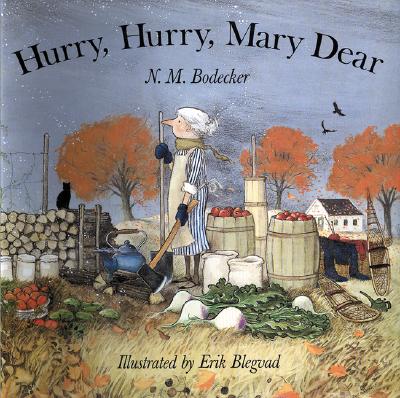
Hurry, Hurry, Mary Dear

by N.M. Bodecker
Illustrated by Erik Blegvad
Published by Margaret K. McElderry Books
Copyright © 1998

Here in Somerset, Pennsylvania we know what it is like to have to prepare for winter. In “Hurry, Hurry, Mary Dear” Mary is the person who has to make all the preparation for the impeding cold.

N.M. Bodecker’s a native of Denmark who moved to Connecticut was well familiar with this yearly ritual as well. His quaint and entertaining silly poetry is the fuel for this wonderfully illustrated book. Mary has such a list of things to do that she exhausts herself doing it as if in one day. All the while you catch little peaks of her husband whiling the day away inside. When she finishes though, he gets his comeuppance. “Hurry, Hurry, Mary Dear” is a very entertaining picture book children will love and that wives and mothers will relate to.

LARF

By Ashley Spires
Published by Kids Can Press
Copyright © 2012

I have always had an affinity for the Sasquatch legend. I will freely admit that there is a little part of me that believes that Sasquatch is out there. But even if they aren’t, to believe in them is to retain that sense of unexplainable wonderment in the natural world. So when I saw “Larf,” by Ashley Spires, in our latest children’s book order I knew I had to read it.

Larf, as you may have guessed, is a Sasquatch. He likes the fact that no one knows he exists, and even when they see him they don’t really believe he exists. Larf is the only Sasquatch in the world and he loves his privacy.

While reading the newspaper one day he reads an article that says that “a Sasquatch is scheduled to make an appearance today in the nearby city of Hunderfitz.” Larf wonders how this could be, and then he wonders how this could affect him. Larf has no choice; he must go to Hunderfitz to see this Sasquatch. Larf is in for a surprise.

The story of Larf is cute. As much as I hate the word “cute” there is no other word that fits. There is no deep layer of morality to this tale it is just cute. Sure you could look at it as a tale about getting out of your own head and letting others in so that we can make friends, but that is merely an aside to the cuteness.

Fortunately, “cute” is not the only thing that “Larf” has going for it. This story is very humorous. Most of this humor shows up in the illustrations. Spires’ line art is reminiscent of the work of Craig Bartlett on the Nickelodeon cartoon “Hey, Arnold” (which I loved), but she lightens it up and makes it more whimsical and fluffy with her use of what seems to be water color. The funny comes not just in her way of drawing people and Larf, but in the way she juxtaposes the text of the story with the illustrations. For instance when we read “Larf knows no one would ever leave him alone if they found out he was real.” And then we see an illustration with his face on the cover of magazines, newspapers, and tabloids with the addition of a book featuring his pet bunny Eric on the cover with the title “Bigfoot’s Bunny: Shocking Tell-All Memoir.” It made me laugh.

In addition to the humor, if you pay close attention to the illustrations Spires shows us what is coming at the end of the story, but you really have to read the pictures. So this makes a great little activity for kids while reading this book, especially the second time around.

This book will definitely get five stars on my book sharing accounts. It will be a welcome addition to the story time rotation for children’s groups or individual children ages 3 and up.  

Friday, May 18, 2012

You Killed Wesley Payne

By Sean Beaudoin
Published by Little Brown
Copyright 2011

Pulp Fiction P.I.'s meet high school in this mysterious and funny novel. You'll never look at high school cliques the same again.

Dalton Rev is a teenage private detective with a serious case to crack. Macy Payne has hired Dalton to find out who killed her brother and upon being intercepted by the principal (Principal Inference) he has also found a second case – tracking down $100,000 in stolen racket money.

Wesley Payne was found dead, wrapped in duct taped and hanging from a goal post at the Salt River High School football field. It becomes apparent to Dalton very soon that Wesley’s death is not the suicide it was cracked up to be. Salt River High is out of control with two raging cliques that want to rule the school, the Balls and the Pinker Caskets, and the various fringe and hangers-on cliques. The Fack Cult T is more than willing to look the other way as long as their price is met. The only thing that keeps the school from full scale violence is the looming threat of the Lee Harvies, who thwart violence with the threat of violence. This is going to be a tough case for Rev to crack by himself.

Sean Beaudoin has written your classic pulp-fiction novel that is updated with a seriously modern and off the wall cast of jocks, geeks, nerds, preps, goths, psychopaths, and depressed loners. And don’t forget those tough as nails police detectives that inevitably have to be circumnavigated. “You Killed Wesley Payne” is prison rules high school with high fashion, tough mystery, snarky Ironic humor, and witty banter.

This is an awesome book for high level teens (grades 9-12). While some content in this book is a little edgy, I applaud him for accomplishing this without the excessive use of foul language which tends to find its way into high level YA Literature. I love Beaudoin for bringing back the hard-boiled mystery/crime genre. This book is going to resonate with teens of every ilk because of Dalton’s anti-superhero, how many times can I be beat unconscious, everyman persona, as well as for the plethora of cliques that will enable most teens to find someone they relate to.

The Beastly Arms

By Patrick Jennings
Published by Scholastic Press
Copyright © 2001

“The Beastly Arms” is an intriguing book about seeing more than what is obvious and learning to trust. Nickel is an observant boy who loves to practice photography. He and his friend Inez also love animals – Miriam, a Kangaroo rat, can usually be found hiding in Nickel’s shirt pocket.

Nickel and his mom have to move because their current landlord keeps raising their rent. His dad wants them to move to the suburbs near him, but they don’t want to leave the city. The only problem is that it is so hard to find an affordable apartment that isn’t in a horrible neighborhood. One day while Nickel and his mom were out apartment hunting they stumble across a creepy building called the beastly arms. This building piques Nickel’s curiosity and he just has to know more about it and it’s owner Mr. Beastly.

While not full of action or magic this book is certainly brim full of imagination. When you find out what Mr. Beastly’s secret is you will be amazed.