By Sarah Stewart
Illustrated by David Small
Published by Farrar Straus Giroux
Copyright ©1998
It is the Great Depression and Lydia Grace Finch is being sent to live with her unsmiling uncle in the big city until her parents get back on their feet. Lydia may have to leave her country home, but she is determined to continue gardening just like her grandmother taught her. She uses this skill deftly to make her Uncle’s Bakery beautiful and to create a surprise for him that will make him smile.
This is a touching and light hearted book that subtly and quietly teaches so much. This picture books is great for the home library, but it would also make a great companion to an elementary school Great Depression history lesson.
Showing posts with label Picture Books. Show all posts
Thursday, June 7, 2012
Tuesday, June 5, 2012
Click, Clack, Moo: Cows That Type
By Doreen Cronin
Pictures by Betsy Lewin
Published by Simon & Schuster
Copyright © 2000
Doreen Cronin and Betsy Lewin have brought us a must read picture book that strikes a blow for workers everywhere!
“Click, Clack, Moo” is a picture book that tells the story of Farmer Brown’s Cows who have somehow gotten their hands on a typewriter. Not only that but they are literate enough to use it to type some notes for the farmer. They have a problem with the barns working conditions that they would like remedied.
Labels:
Barns,
Book Reviews,
Farm Animals,
Humor,
Picture Books
Thursday, May 24, 2012
Little Mouse Gets Ready
by Jeff Smith
Published by A Toon Book
Copyright ©2009
Jeff Smith is the creator of many comic books. Most notable among them is the Bone series. Here though Jeff Smith has been tapped to write a first comic for brand new readers. I for one think it is wonderful.
The illustrations scream Jeff Smith and the story is short (no pun intended) and sweet. Little mouse has to get ready to go to the barn with his family, so little mouse shows us how he gets ready. I don’t want to give it away, but there is a nice little ending that will even give adults a quick chuckle.
A Theodor Seuss Geisel Honor Book
Wednesday, May 23, 2012
Snowflake Bentley
By Jacqueline Briggs Martin
Illustrated by Mary Azarian
Published by Houghton Mifflin Company
Copyright © 1998
When I was a child I loved snow. I loved Snow balls, snow forts, snowmen, snow angels, and even just snow tunnels. But Jacqueline Martin has shown me someone who loved snow even more than I did. “Wilson Bentley was born February 9, 1865, on a farm in Jericho, Vermont.”
Vermont is generally considered a winter wonderland from November to March when it is most often covered in snow. Snow is probably the only thing more plentiful than cows in Vermont. And yet something that was so common, and to many Vermonters obtrusive, was beautiful and magical to William Bentley. He was so taken with snow that he devised a way to take photographs of individual snowflakes. Of course William Bentley liked to photograph nature at all times of the year spring, summer, and fall, but his most notable photographs are of winter’s snowflakes. So, he became known as “Snowflake Bentley”.
This is a wonderful non-fiction picture book that instills a child like sense of wonder in even the oldest reader, taking them back to the days when they loved snow too. This book is not just about snow though, it is about doing what you enjoy because you love it, not because it makes you rich. Great book for children ages 4-8.
Labels:
Book Reviews,
Photography,
Picture Books,
Snow,
Vermont
Tuesday, May 22, 2012
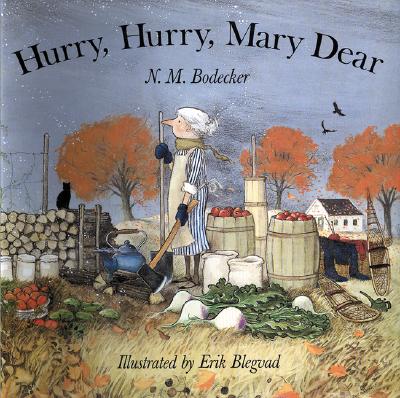
Hurry, Hurry, Mary Dear
by N.M. Bodecker
Illustrated by Erik Blegvad
Published by Margaret K. McElderry Books
Copyright © 1998
Here in Somerset, Pennsylvania we know what it is like to have to prepare for winter. In “Hurry, Hurry, Mary Dear” Mary is the person who has to make all the preparation for the impeding cold.
N.M. Bodecker’s a native of Denmark who moved to Connecticut was well familiar with this yearly ritual as well. His quaint and entertaining silly poetry is the fuel for this wonderfully illustrated book. Mary has such a list of things to do that she exhausts herself doing it as if in one day. All the while you catch little peaks of her husband whiling the day away inside. When she finishes though, he gets his comeuppance. “Hurry, Hurry, Mary Dear” is a very entertaining picture book children will love and that wives and mothers will relate to.
LARF
By Ashley Spires
Published by Kids Can Press
Copyright © 2012
I have always had an affinity for the Sasquatch legend. I will freely admit that there is a little part of me that believes that Sasquatch is out there. But even if they aren’t, to believe in them is to retain that sense of unexplainable wonderment in the natural world. So when I saw “Larf,” by Ashley Spires, in our latest children’s book order I knew I had to read it.
Larf, as you may have guessed, is a Sasquatch. He likes the fact that no one knows he exists, and even when they see him they don’t really believe he exists. Larf is the only Sasquatch in the world and he loves his privacy.
While reading the newspaper one day he reads an article that says that “a Sasquatch is scheduled to make an appearance today in the nearby city of Hunderfitz.” Larf wonders how this could be, and then he wonders how this could affect him. Larf has no choice; he must go to Hunderfitz to see this Sasquatch. Larf is in for a surprise.
The story of Larf is cute. As much as I hate the word “cute” there is no other word that fits. There is no deep layer of morality to this tale it is just cute. Sure you could look at it as a tale about getting out of your own head and letting others in so that we can make friends, but that is merely an aside to the cuteness.
Fortunately, “cute” is not the only thing that “Larf” has going for it. This story is very humorous. Most of this humor shows up in the illustrations. Spires’ line art is reminiscent of the work of Craig Bartlett on the Nickelodeon cartoon “Hey, Arnold” (which I loved), but she lightens it up and makes it more whimsical and fluffy with her use of what seems to be water color. The funny comes not just in her way of drawing people and Larf, but in the way she juxtaposes the text of the story with the illustrations. For instance when we read “Larf knows no one would ever leave him alone if they found out he was real.” And then we see an illustration with his face on the cover of magazines, newspapers, and tabloids with the addition of a book featuring his pet bunny Eric on the cover with the title “Bigfoot’s Bunny: Shocking Tell-All Memoir.” It made me laugh.
In addition to the humor, if you pay close attention to the illustrations Spires shows us what is coming at the end of the story, but you really have to read the pictures. So this makes a great little activity for kids while reading this book, especially the second time around.
This book will definitely get five stars on my book sharing accounts. It will be a welcome addition to the story time rotation for children’s groups or individual children ages 3 and up.
Labels:
Big Foot,
Book Reviews,
Humor,
Picture Books,
Sasquatch
Friday, May 18, 2012
A Hen for Izzy Pippik
By Aubrey Davis
Illustrated by Marie Lafrance
Published by Kids Can Press
A folksy multicultural tale of honesty and integrity replete with chickens, but no chicken soup or fricassee for you, these are Izzy Pippik’s chickens.
Shaina lives in a poor village. One day she finds a beautiful hen at her doorstep and she learns that it belongs to Izzy Pippik. Even though her family wants to eat it, she knows that she should save it for Izzy Pippik because he will surely return for such a fine chicken. Her family relents, but when the hen has many chicks, and the chicks have chicks of their own, they become a nuisance to her family and to the whole town. Shaina still believes she must care for the chickens until their owner returns. Slowly though, the town begins to like the chickens because they returned good fortune to the town, but will Izzy Pippik ever return for his chickens?
“A Hen for Izzy Pippik” is a wonderful tale about doing the right thing even when it is unpopular. Shaina does the right thing not just once but many times. In Shaina we also find a selfless example of a young person doing what is right, not for what she will get out of it, but because it is the right thing to do.
This universal moral, is derived from “Jewish and Islamic traditional text.” Marie Lafrance’s illustrations really add to the universality of this story as they have a very simplistic French/European appeal. This multicultural tale will be a pleasure to read to your children, and not only will they get the moral, but I think they just might have a blast trying to find and count all of the chickens that Lafrance has drawn into this book. (For children 4 years and up.)
Tuesday, May 8, 2012
The Three Questions
Written and Illustrated by Jon J. Muth
Published by Scholastic Press
Copyright © 2002
When is the best time to do things?
Who is the most important one?
What is the right thing to do?
In this picture book young Nikolai wants to be a good person, but he feels that he needs the answers to the above questions in order to be good. His friends (a heron, a monkey, and a dog) try to help him but their answers don’t seem satisfactory, so he sets off to talk to Leo the turtle. Leo helps Nikolai to see that he had the answers to the questions all along when he compares it to Nikolai’s selfless actions.
“The Three Questions” is based on a Leo Tolstoy story of the same name. The watercolor illustrations are muted and subtle, yet beautiful. Unlike many picture books where the story plays second fiddle to the pictures, the illustrations in this book serve to accentuate the story. The use of personification in animal characters rather than using humans makes the story more appealing to children and hopefully it will help them understand the goodness that comes from giving of oneself.
Monday, April 23, 2012
Sugaring
By Jessie Haas
Illustrated by Jos. A. Smith
Published by Greenwillow Books
Copyright © 1996
I was born in Northwestern Massachusetts, just south of the Vermont line. This is still very much near the heart of maple sugaring country. As a matter of fact we only lived a few miles from Gould’s Sugarhouse which was on route 2 also called the Mohawk Trail. Living in rural New England spoils a lad when it comes to maple syrup; no Mrs. Butterworth’s or Log Cabin for me. Though I no longer live in New England I am very fortunate to live in the Laurel Highlands of Pennsylvania which is also a maple syrup producing area. It is because of my love of maple syrup that I read the children’s picture book “Sugaring.”
Early spring is sugaring season, and Nora is collecting sap with her Gramp. The sap itself tastes like sweet water. And they can’t wait to get it back to their sugar shack to make it into something even sweeter, maple syrup. Nora also helps her Gramp as he boils down the sap. When they finally have maple syrup Nora thinks that the horses should have some since they did all the hauling.
“Sugaring” is entertaining and informative look at the charming and old fashioned process of maple sugaring. It provides us with the simple details of how sap is collected and turned into maple syrup while at the same time telling the story of a girl who thinks that all workers, even horses, should be rewarded for their labor.
Of course, sadly, maple syrup is rarely collected with buckets, horses, and sleds anymore. Often they use tubing that is gravity fed down to the sugarhouse. And while wood is still used to heat the evaporators some producers use oil or other fossil fuels. If you are fortunate though you will still find an operation that keeps the old fashioned tradition of making maple syrup alive.
“Sugaring” is a great book to read with inquisitive children (ages 4-8) who want to know where maple syrup comes from. I plan on making its reading an addition to my own personal maple festival.
Subscribe to:
Posts (Atom)